
A PAT test certificate is a short document confirming that a set of electrical appliances was inspected and tested on a given date, with the number that passed and failed and a recommended date for the next test. It does not expire in law. The retest date is a recommendation based on risk, and the detail for each appliance sits in a separate report. This guide covers what each PAT document is for, which ones are worth keeping and what landlords, schools and offices are usually asked to produce.
What is a PAT test certificate?
The certificate is the summary page. It names the business that did the testing, the client and the site, the date, and how many items were covered. It usually gives the tester's name and a retest date as well. Think of it as the cover sheet for the job: it tells a reader that testing happened, and the report tells them what the testing found.
Nothing in law fixes what a certificate must look like. The HSE's FAQ on portable appliance testing and its leaflet Maintaining portable electric equipment in low-risk environments (INDG236) do not mention test certificates at all. Layouts therefore vary between companies, which is why it helps to know what a good one contains.
We issue the certificate on the spot, before we leave the site, and the report lists every item with its asset ID, test values and result. The PAT testing page explains how a visit runs from start to finish.
PAT certificate, report, label and asset register: what is the difference?
People use "certificate" to mean four different things, and that causes most of the confusion when an insurer or agent asks for "the PAT paperwork". Each record answers a different question, and none of them replaces the others.
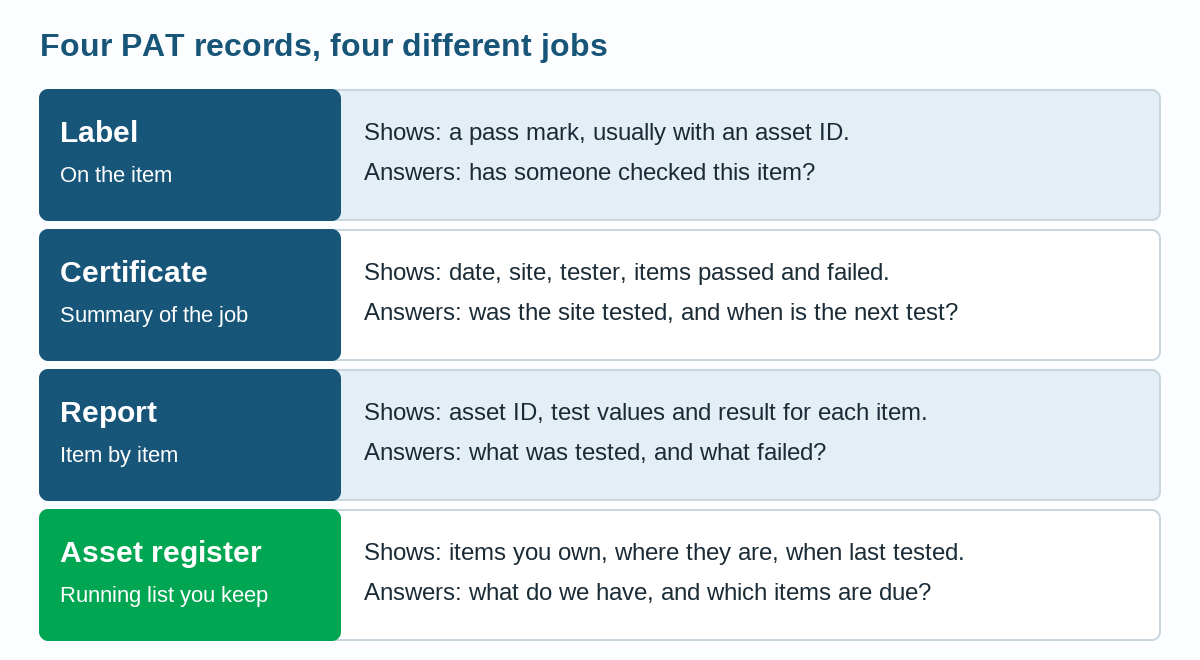
The label is the sticker on the plug or casing. It tells you someone has checked the item, but it cannot tell you how, or what the readings were. Our guide to PAT testing label colours explains why a green sticker on its own proves very little.
The report is where the evidence sits. If someone asks whether the kettle in the staff room passed, the report answers that, and the asset ID on the label lets you match the physical kettle to its line. The asset register is the running list you keep of everything you own, where it lives and when it was last tested. For a small site the report can double as the register. For a large one, such as a school or a multi-room building, a register that you update between visits is worth the effort.
What should a PAT test certificate contain?
A useful certificate lets a stranger understand the job without phoning anyone. The example layout below uses placeholder values and is not a real client record. Companies lay these pages out differently, but most of the same fields turn up.
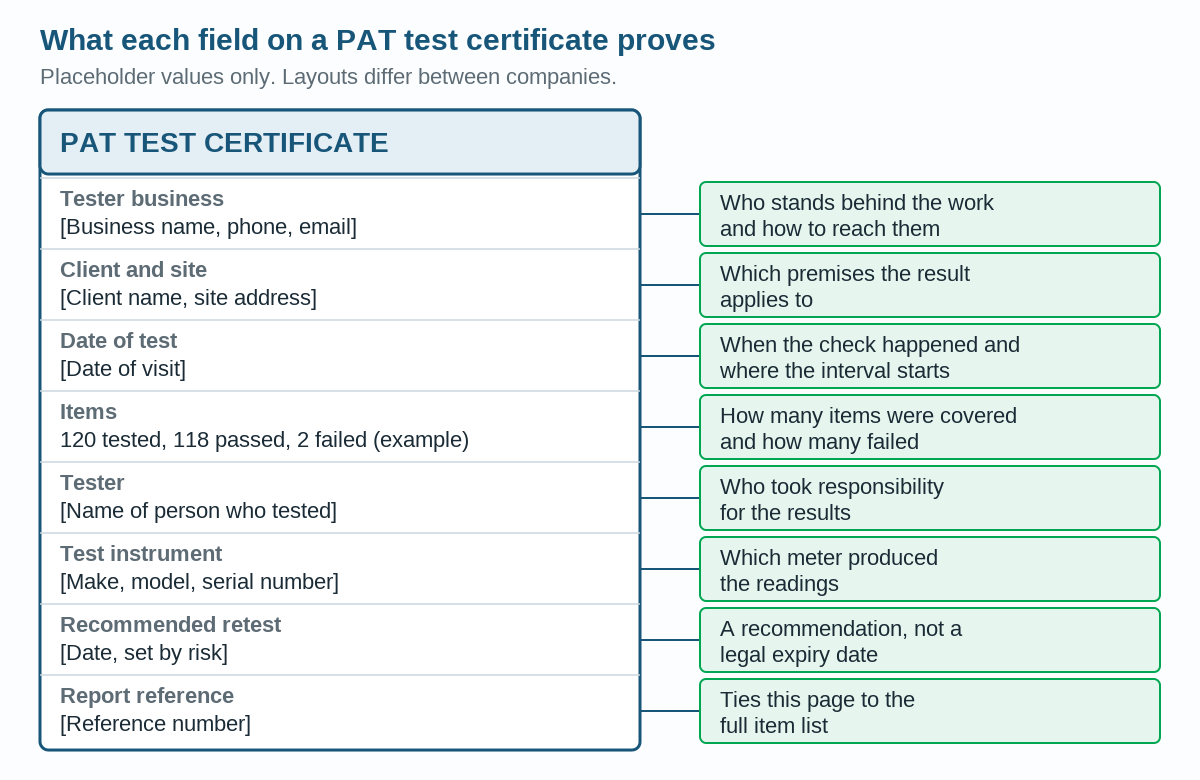
The fields that matter most are the date, the site and the count of items passed and failed. Without the date, nobody can tell whether the testing is recent. Without the site, the document could belong to any premises. Without a count, there is no way to check whether the tester covered everything.
The test instrument line is less common on cheaper certificates, but it is a good sign. It shows which meter produced the readings, so a query can be traced back to a specific piece of equipment. The report reference is just as useful, because it stops the certificate drifting away from the evidence it summarises.
Does a PAT test certificate expire?
No law gives a PAT test certificate an expiry date. The HSE says there is no legal requirement to test portable appliances at all. What the Electricity at Work Regulations 1989 require is that electrical equipment is maintained so far as is reasonably practicable to prevent danger, and the HSE's FAQ says how often to inspect and test depends on the type of equipment and the environment it is used in. The retest date on a certificate is therefore the tester's recommendation, and others often read it as the date the next test is due.
The IET Code of Practice for In-Service Inspection and Testing of Electrical Equipment, now in its 5th edition (2020), removed the old table of fixed intervals. The IET's own Wiring Matters article on the 5th edition says the table "has now disappeared" and was not replaced, and that there is "no right or wrong answer" in setting an interval. It lists the environment, the users, the type of equipment and previous records among the factors to weigh.
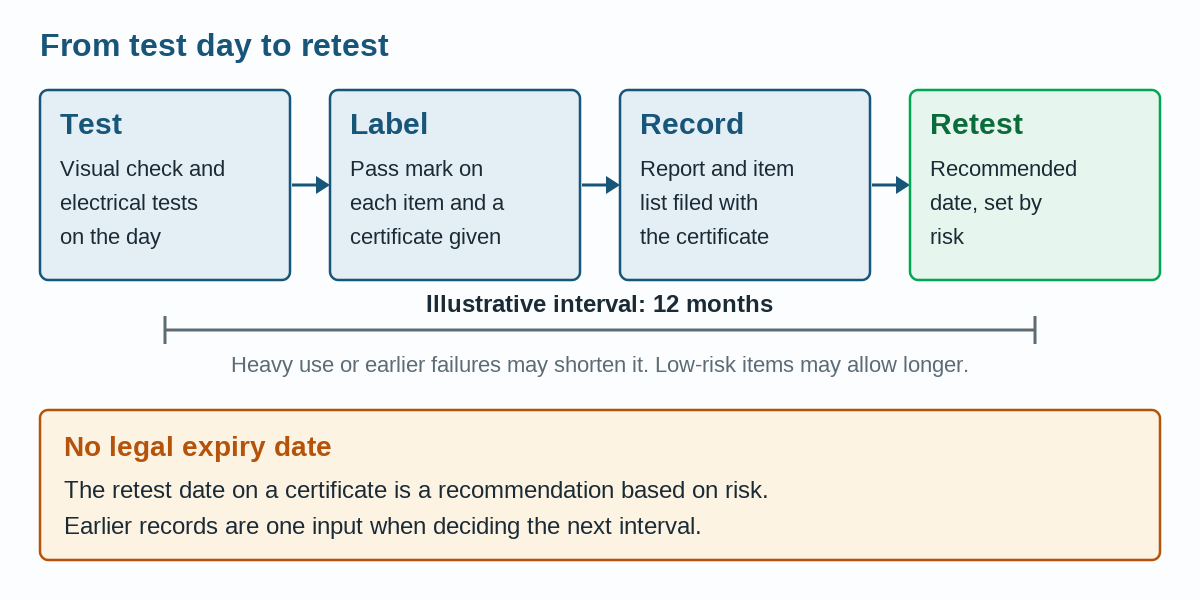
So a certificate that says "retest in 12 months" is not out of date on day 366 in any legal sense. It does mean the recommendation has lapsed, and an insurer or auditor may ask why nothing was done since. Our post on how often you should PAT test goes through how the interval is chosen for different kinds of premises.
Do you have to keep PAT test records, and for how long?
Keeping records is good practice and not a legal duty. INDG236 puts it this way: "You may find it useful to keep records of all inspections and tests, and to label equipment with the result and date of the test, but there is no legal requirement to do either of these things." The HSE FAQ repeats the point and calls a record and labelling "a useful management tool".
The IET article makes a practical case for them as well. It says previous records "should be used to evaluate the required frequency" of later checks, because they give a history of the environment and its users. A site that has kept its reports can spot the same appliance failing at every visit, and can shorten its interval to match.
Neither the HSE pages nor the IET article I read sets a retention period, so we will not invent one. Three sensible anchors exist. The first is to keep at least the current report and the one before it, so you can see what changed at the last retest. The second is to ask your insurer, because some policies set their own conditions. The third is the time limit for legal claims. Under the Limitation Act 1980, section 2, a tort action cannot be brought after six years from when the cause of action accrued, and section 5 sets the same period for simple contract. Some claims run on different clocks, so treat six years as a reference point and take advice if a specific dispute is in view.
Paper or digital both work. A PDF report stored somewhere your colleagues can find it is easier to search than a folder in a filing cabinet, and it survives a change of office manager. If you keep paper, scan it and store the scan with a clear file name that includes the site and the test date.
What do landlords, schools, offices and insurers ask to see?
Requests vary, and the grid below shows common ones rather than a legal list. Your lease, your school or trust policy and your insurance wording decide what you actually need, so read those before assuming anything.
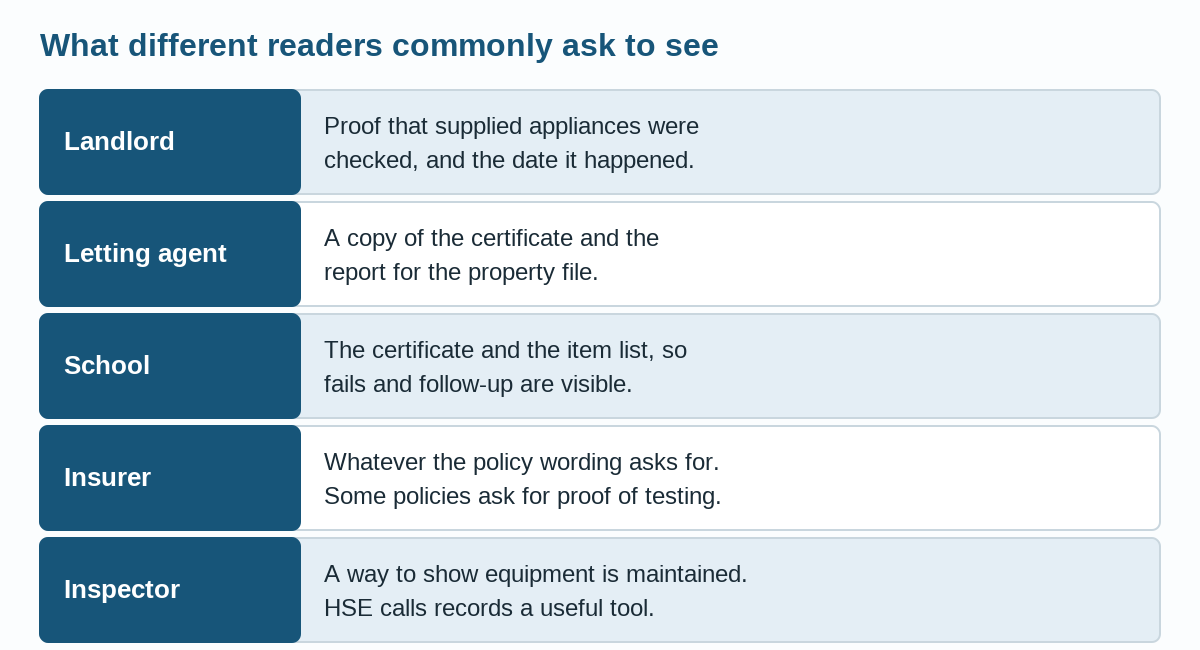
For landlords and agents the certificate alone is often the first thing requested, with the report following if a tenant or a deposit scheme queries an item. Our landlord PAT testing page covers what to supply and what is the tenant's own equipment. Schools and offices tend to want the full item list because they have many users and several rooms, and a manager needs to see which room a failed item came from.
Insurers are the least predictable, since each policy differs. Our post on insurance and PAT testing sets out what we can and cannot say about cover. If a claim ever follows an electrical fire, a dated certificate and a report that names the item are better evidence than a sticker with no paperwork behind it.
How do you read a report line and handle failed items?
A report line normally carries the asset ID, a description, the location, the appliance class, the test results and a pass or fail. Class I items, which rely on an earth connection, are tested for earth continuity and insulation. Class II items, which are double insulated, are tested for insulation only. Some lines may show a visual-only check where an electrical test was not appropriate for the item. If a column is not clear to you, ask the tester, because a good tester can explain a line in a sentence.
Failures belong on the record, and they should stay visible there until something has been done. We label a failed item, take it out of use and list it in the report with the reason. Once it has been repaired and retested, or replaced, the register should show the new result and the date. Our guide on what to do when an appliance fails a PAT test covers repair, replacement and retirement. The part to get right for your records is the follow-up entry: a failed line with no action noted looks like an open problem to anyone reading it later.
It also helps to ask at handover how the retest date was chosen. A tester who can say it reflects the mix of equipment, how heavily it is used and what failed last time is applying the risk-based approach the HSE describes. A tester who gives the same interval for every customer without explanation may simply be following a habit. Both are lawful, but the first gives you something to put in your records beside the date.
What if a certificate is lost, old or looks wrong?
If you have lost a certificate, ask the company that issued it for a copy. Many companies keep their own copies, though how long they hold them differs from firm to firm, so ask early. If the company has closed or cannot be reached, you cannot rebuild the original. The practical answer is a new inspection and test, with a fresh certificate and report that you store properly this time.
An old certificate still shows that testing happened on that date, which has some value, but it does not show the current state of the equipment. Appliances get moved, dropped and replaced, so an old set of results does not describe them. Treat it as history and plan a new test.
Before filing a new one, run through the checks below. Most of the problems we see in other people's paperwork fall into one of them.
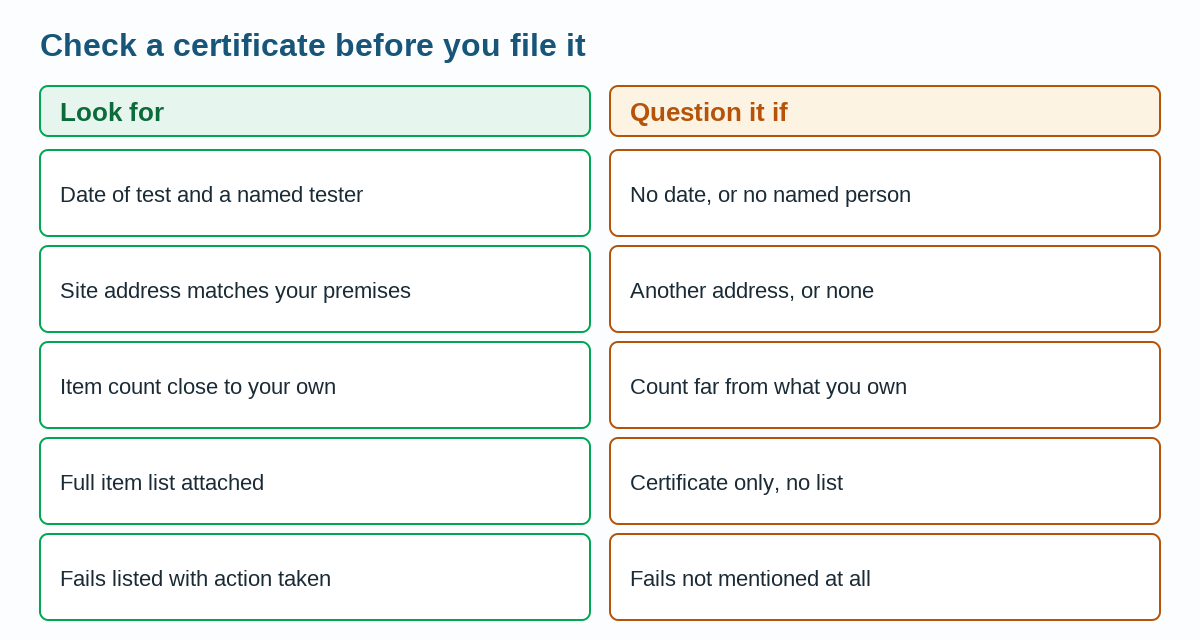
For example, if a certificate says 120 items were tested, 118 passed and 2 failed, the report should show 120 lines, with two marked as fails and a reason against each. If it shows 90 lines, or no fail lines at all, something does not add up, and it is worth asking the tester before you file it.
A certificate with no report behind it is a common problem, and it is a real one: you cannot see what was tested or what failed. Ask for the item list before you pay for the job, and compare the item count with your own idea of how many appliances you have. If the two are far apart, either the tester missed equipment or the count is a guess.
If you would like your records sorted out, or want a certificate and item-by-item report you can file and find again, text or call Chris Thomas on 07525 755 632 or email testing@peakedgepat.com. Our contact page has the other ways to reach the Chesterfield branch, and reviews show what other customers have said about our work.
Frequently Asked Questions
Does a PAT test certificate expire?
No law gives a PAT test certificate an expiry date. The HSE says there is no legal requirement to test portable appliances, only to maintain electrical equipment so it does not cause danger. The retest date on the certificate is the tester's recommendation, based on how and where the equipment is used. An insurer or auditor may still expect you to act on that date.
Is it a legal requirement to keep PAT test records?
No. The HSE leaflet INDG236 says you may find it useful to keep records of inspections and tests, and to label equipment, but there is no legal requirement to do either. Records are still worth keeping because they show that maintenance happened, and they help you decide how often to retest. Some insurers and landlords also ask to see them.
How long should I keep PAT test records?
The HSE and IET sources I read give no fixed retention period. A sensible approach is to keep at least the current and previous reports, ask your insurer whether its policy sets a period, and bear in mind that many contract and tort claims have a six-year limit under the Limitation Act 1980. Take advice if a particular dispute is involved.
What is the difference between a PAT certificate and a PAT report?
The certificate is a short summary of the job: who tested, where, when, how many items passed and failed, and a recommended retest date. The report lists every item, normally with its asset ID, description, location, test values and result. You usually need the report to see what actually failed. Peak Edge PAT issues both, and the certificate is handed over on the spot.
What should I do if my PAT certificate is lost?
Ask the company that issued it for a copy, because most keep their own records for some time. If that company has closed or cannot find it, you cannot reconstruct the original. A new inspection and test gives you a current certificate and report, which is more useful than an old one anyway, since appliances change between visits.