
How to choose a PAT testing company comes down to five checks before you book. Look for evidence of training and competence, calibrated test equipment, public liability insurance, a report that lists every item with its test values, and a quote that says exactly what is included. Nothing in law forces you to pick someone from a particular register, so the checks are yours to make, and a good company will expect them. Here is how to make them, and what a fair answer sounds like.
Is there a licence or register for PAT testers?
We have found no law that requires a PAT tester to hold a licence or sit on an official register. The Health and Safety Executive says on its portable appliance testing FAQ page that the person doing the work needs to be competent, and that you do not need to be an electrician to carry out visual inspections. It also says combined inspection and testing needs a greater level of knowledge and experience.
The legal anchor, if you want one, is regulation 16 of the Electricity at Work Regulations 1989. It says nobody should be engaged in work where technical knowledge or experience is necessary to prevent danger, unless they have that knowledge or experience or are suitably supervised. That is a competence test, not a licensing scheme.
Voluntary trade schemes do exist, and some tester membership bodies publish their own working standards. Membership can be a useful signal, but it is a choice the business has made. It is not something the law asks for, so treat it as one piece of evidence and not as proof on its own.
What does a competent PAT tester look like?
Competent means the person has the training, skills and knowledge to do the task safely. HSE adds three practical points for testing: the right equipment, the ability to use it properly, and the ability to understand the results, in its leaflet Maintaining portable electric equipment in low-risk environments.
Training courses in in-service inspection and testing are run by several providers, and many testers have completed one. None is a legal requirement, and the trade body whose standards we read says a certificate on its own does not prove competence. A good question to ask is what training the tester has had, how long they have been doing the work, and how they stay up to date. Someone who knows the work can answer that in a minute without hedging.
The Code of Practice they work to is worth asking about too. The current document is the IET Code of Practice for In-Service Inspection and Testing of Electrical Equipment, 5th edition, published in 2020. There is no 6th edition, and our piece on the 6th edition myth explains where that rumour comes from. A company that cites the 4th edition or a 6th edition has told you something about its paperwork.
Does the tester use calibrated equipment?
A PAT tester gives readings, and the readings are only worth trusting if the instrument is accurate. Calibration is the process of checking it against a known reference, and a calibration certificate is the record that it happened and when.
We could not find a legal calibration interval, and we have not invented one. The trade body standards we read say it is not a legal requirement to calibrate testers regularly, but they expect machines to be checked for correct calibration periodically, and at least yearly if they are heavily used. They also expect the certificate to be available to the customer on request. What the IET Code itself says about calibration is worth checking in the current text, because we could not read it online.
In practice, ask to see the certificate and look at the date. A tester who has one to hand and is happy to show it is easy to work with. A tester who cannot say when the instrument was last checked has given you a reason to keep looking.
Do they carry insurance?
Public liability insurance covers damage or injury caused by the work, for example a fault in a socket made worse during testing. The same trade body standards set public liability as the minimum and expect employers liability as well if the member employs other people. Neither is a legal condition of being a PAT tester, so the only way to know is to ask, and a proper company can send a certificate by email.
If your own insurer asks questions about electrical safety, see how insurance and PAT testing fit together. Do not assume a particular result from any of this, and read your own policy wording carefully before relying on it.
What should a PAT testing report contain?
This is where companies differ most, and where you can judge quality before paying anything. Ask for a sample report. A useful one lists every item tested, one line each, so you can see what was actually done.
- An asset ID that matches the label on the item.
- The location, so a failed item can be traced to a room.
- A description and the equipment class, because the class decides which tests apply.
- The measured test values, not only a tick.
- A pass or fail result for each item, with a reason for any fail.
- The test date and the name of the person who tested.
- The retest interval that was agreed.
HSE points out that testing only shows the state of an item on the day. It also says the decision about when the next test is due should be made by the duty holder on a risk basis. A tester can suggest an interval, and the report should record the one you agreed. Our guide to how often to PAT test covers how those intervals are usually set.
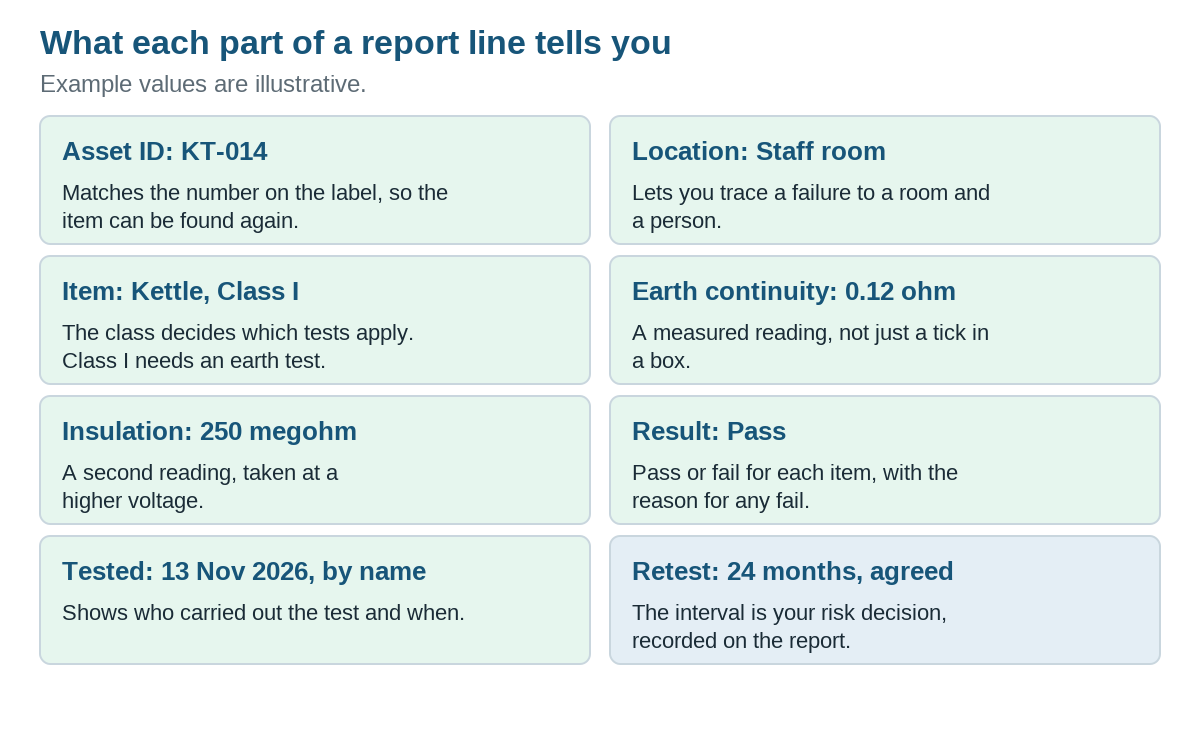
At Peak Edge PAT, the report lists every item with its asset ID, test values and pass or fail result. Certificates are issued on the spot, so you leave the visit with paperwork and not a promise to send it later. Failed items are labelled and taken out of use before we go.
Are labels and certificates on the day necessary?
HSE states there is no legal requirement to label equipment that has been inspected or tested, and no legal requirement to keep records. Both are still sensible. A label with a unique ID is what ties the kettle in the staff room to its line on the register, and the register is what you show anyone who asks. Our guide to PAT test labels and colours explains why the colour on its own means little.
A same-day certificate matters for a practical reason. If the paperwork arrives a fortnight later, you cannot check it against the items while the tester is still on site. Mistakes in an asset list are far easier to fix on the day.
Per item or day rate: how should you compare PAT testing quotes?
Most small jobs are quoted either per item or as a day rate, and the two behave very differently depending on how many items you have. A per-item price suits a small job with a clear count. A day rate can suit a larger site where the item count is uncertain. Neither is better in general, so compare them on the same job.
The headline figure is rarely the whole price. The usual extras are a call-out charge, travel, a minimum charge, a fee for the report or certificate, and the cost of putting right items that fail. Ask for each in writing. The worked example below uses made-up prices, not ours, to show why.
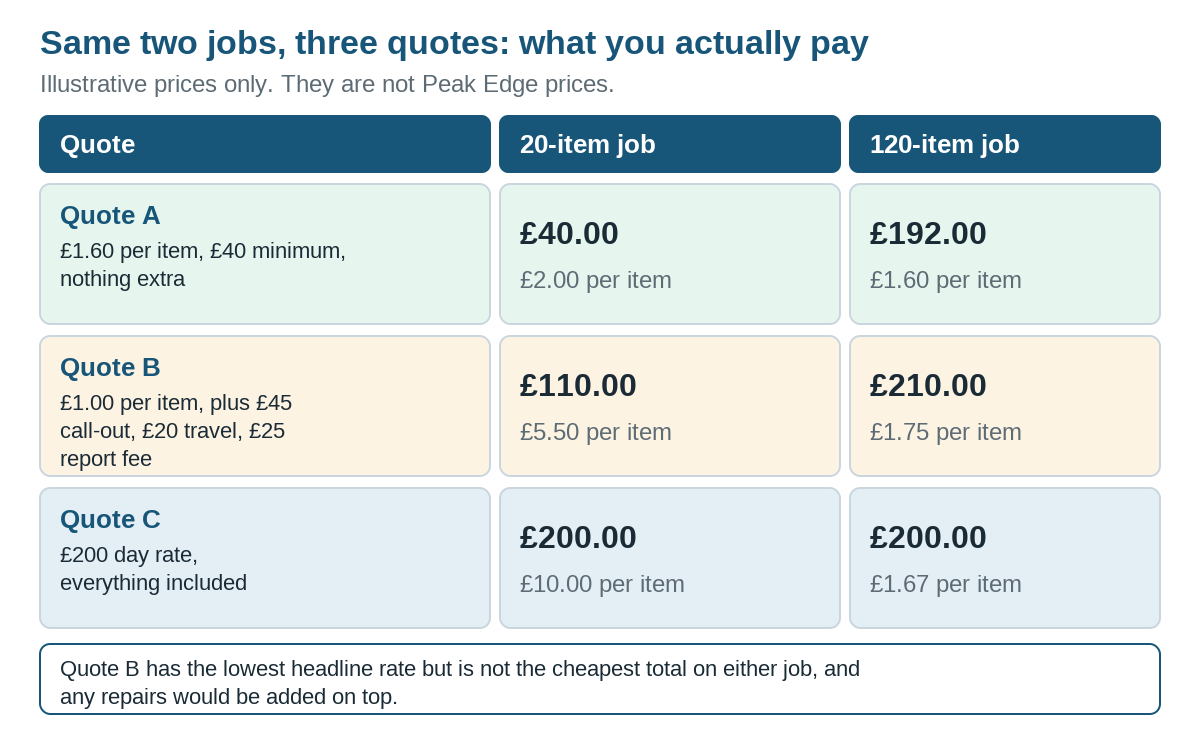
In that example, the quote with the lowest headline rate costs more than the plain per-item quote on both jobs. On the small job the day rate is the most expensive option, and on the larger job it is close to the others. Your own numbers will differ, which is why a quote built around your item count tells you more than any rate card. Our post on how much PAT testing costs goes through what drives the price.
What to ask about failed items
Repairs are the most common surprise. Some items fail because of a loose plug connection or the wrong fuse, which can be fixed quickly. Others fail for good reasons and need replacing. Ask whether simple repairs are included, what is charged for them, and whether you are asked before anything is done. HSE says damaged or faulty equipment should be removed from use and either repaired by someone competent or disposed of.
What counts as an item
Ask how items are counted. A detachable kettle lead or a desktop computer and its power cable may each be recorded separately, and extension leads count too. HSE also says double insulated Class II equipment does not need a portable appliance test, though it still needs user checks and visual inspection. A company that tests and charges for every item the same way may be counting differently from one that applies the class rules.
What are the red flags when choosing a PAT testing company?
A few warning signs show up again and again. None proves bad work by itself, but two or three together are a reason to ask more questions.
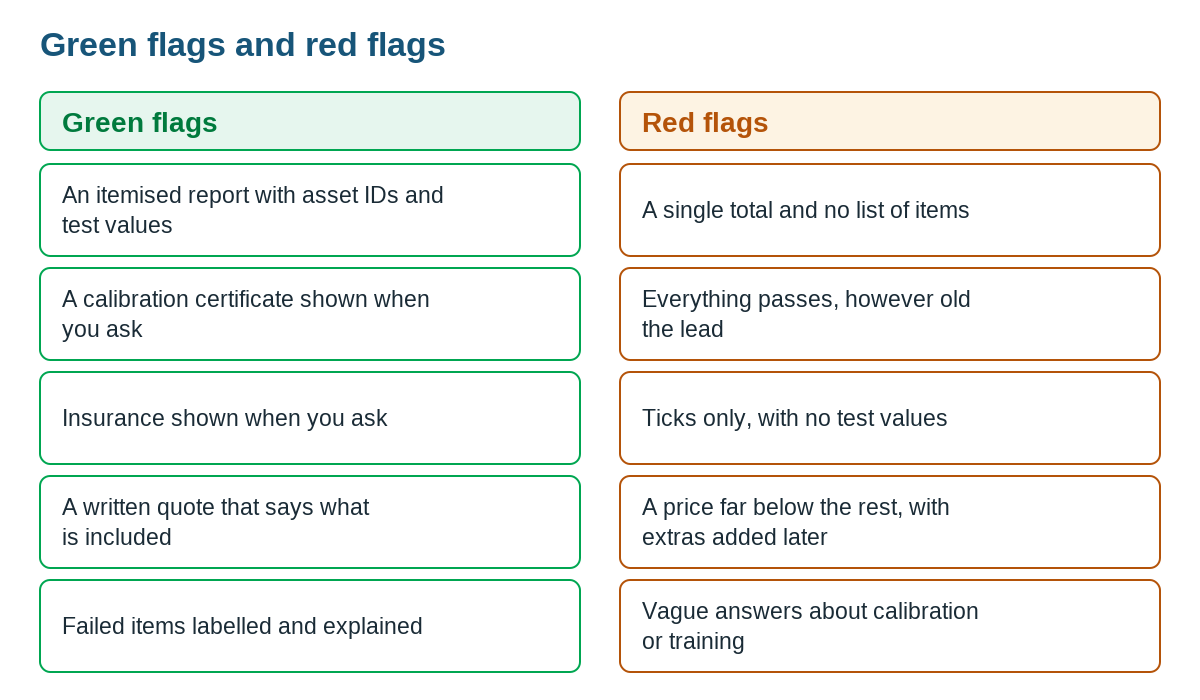
- The report is a single total with no list of items.
- Almost everything passes, however old or worn.
- There are ticks but no test values.
- The price is far below every other quote and extras appear later.
- The answers about calibration, training or insurance are vague or change.
- No asset ID appears on the labels, so items cannot be matched to the register.
The reverse is a reasonable guide to the good signs: a clear written quote, an itemised report with values, evidence shown when you ask, and failed items labelled and explained plainly.
How to choose a PAT testing company: what to ask on the phone
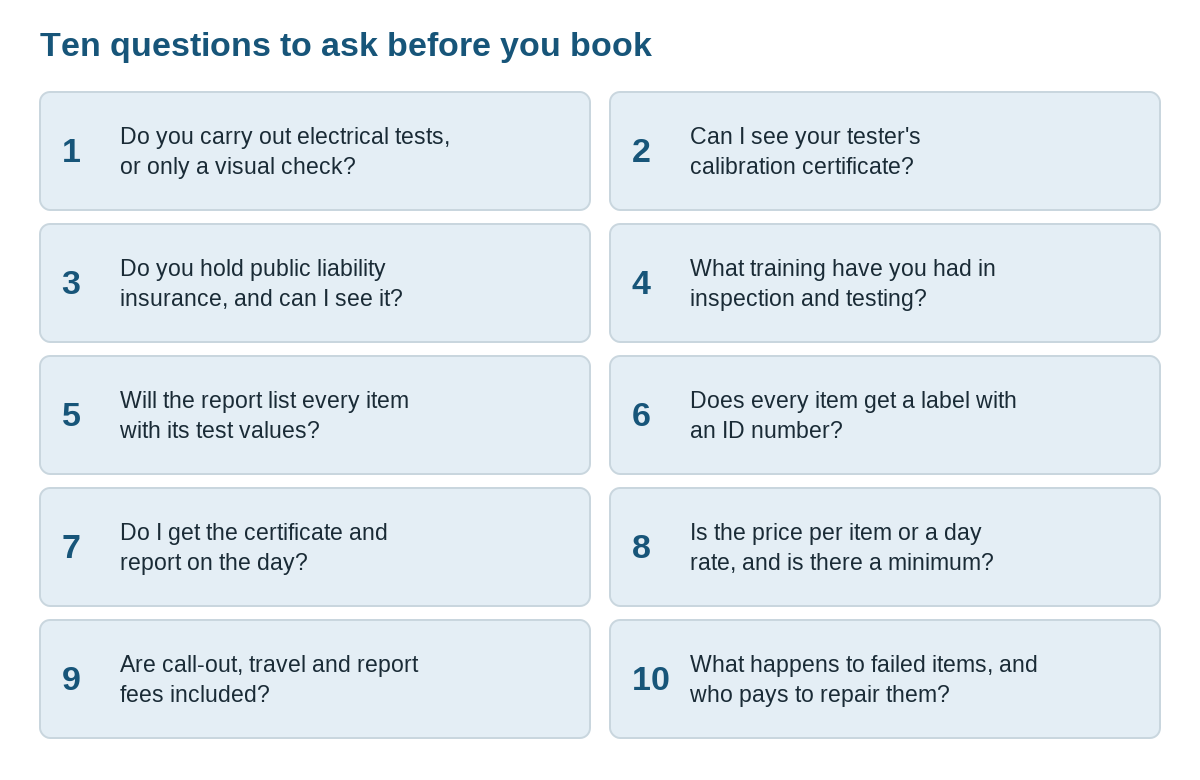
Ten questions cover most of it, and you can ask them in about five minutes. Do you carry out electrical tests as well as a visual check? Can I see your tester's calibration certificate? Do you hold public liability insurance? What training have you had? Will the report list every item with its test values? Does each item get a label with an ID? Do I get the certificate and report on the day? Is the price per item or a day rate, and is there a minimum? Are call-out, travel and report fees included? What happens to failed items, and who pays to repair them?
Past work is worth asking about as well. A company that has tested sites like yours can describe how it handled them, and can point you to written examples or reviews you can read for yourself. Listen to how the questions are received as well as to the answers. If you would like to see how other local jobs went, there are write-ups on our recent jobs page and customer comments on the reviews page. You can read more about how our PAT testing visits work as well.
Where to go from here
If you are in or around Chesterfield and want to put those ten questions to us, text or call Chris Thomas on 07525 755 632, or email testing@peakedgepat.com. Tell us roughly how many items and which rooms, and we will explain what we would do and what it would cost. If another company suits you better, the questions above will still help you choose. You can also use the contact page to reach us.
Frequently Asked Questions
Do PAT testers need to be licensed or registered?
No law we could find requires a PAT tester to hold a licence or sit on an official register. The Health and Safety Executive says the person doing the work needs to be competent, which means having the right training, knowledge and equipment. Voluntary trade schemes exist and can be a useful signal, but membership is the company's choice and is not a legal condition.
Do you need an electrician to do PAT testing?
HSE says you do not need to be an electrician to carry out visual inspections, and that a portable appliance test does not have to be done by an electrician either. It does say testing needs greater knowledge and experience than a visual check, plus the right equipment and the ability to understand the results. Competence matters more than the job title.
How often should a PAT tester's equipment be calibrated?
We could not find a legal interval. Trade body standards we read say calibration is not a legal requirement but expect testers to be checked periodically, and at least yearly if heavily used, with the certificate available to customers on request. For the exact wording in the IET Code of Practice, check the current text. Ask the tester when theirs was last done.
What should a PAT testing report include?
A good report lists every item tested on its own line, with an asset ID matching the label, the location, a description and class, the measured test values, a pass or fail result, the test date and the tester's name. It should also record the retest interval you agreed. A single total with no item list is a warning sign.
Is the cheapest PAT testing quote the best value?
Not necessarily. A low per-item rate can be offset by call-out, travel, minimum and report charges, and by extra costs for repairs to failed items. Ask for a quote for your actual item count that lists what is included, and compare the total. Very low prices also deserve a question about what testing is actually being done.